If you have ever had the opportunity to teach choir in a setting where student participation is mandatory, you may have encountered some issues with behaviour. You may have students who are reluctant to actively participate, or you may have students who are destroying your best efforts with disruptive behaviour. Regardless of your situation, all students benefit from consistency, clear expectations, and differentiated instruction. Here are some strategies to consider implementing in your rehearsal plan. I have outlined a Progressive Discipline approach as well as activities that incorporate movement to assist with your classroom management and to inspire student engagement through choir games.
Progressive Discipline
The best way to ensure that you will not have recurring issues with specific students is to set up a clear and concise Progressive Discipline Chart. Making a chart like this one helps you to stay organized by recording incidents with specific students. Keeping records is so important as it keeps both you and the student accountable. You can also customize the chart for different teaching scenarios. This approach to discipline works best when shared with parents, administrators, other teachers, and students at the beginning of the year.
Incorporating Movement
Some students have difficulty sitting still for a long period of time, especially if the content is not appealing to them. I like to incorporate movement throughout the rehearsal to ensure that students stay as engaged as possible. I also find that if they are required to move, they are less likely to be bothering the person sitting next to them or wrinkling the corners of the music you just handed out.
Strategy #1
At the beginning of the rehearsal, try some basic stretching. I generally focus on the upper body (neck, shoulders). This will help to get their bodies ready to sing but can also help to give them a boost of energy after a long school day. Stretching can be a good focusing activity, and a teachable moment to discuss things like correct alignment for singing. You can also experiment with tension and release in different areas of the body.

Strategy #2
Another excellent way to incorporate movement is with some body percussion. I have experimented with call and response as well as actual notated body percussion music. You can also try assigning a movement for each rhythm (ex. quarter note=clap, eighth note=snap, sixteenth note=pat thighs). This strategy appeals to the kinaesthetic learner while embedding a stronger understanding of rhythm for all students.
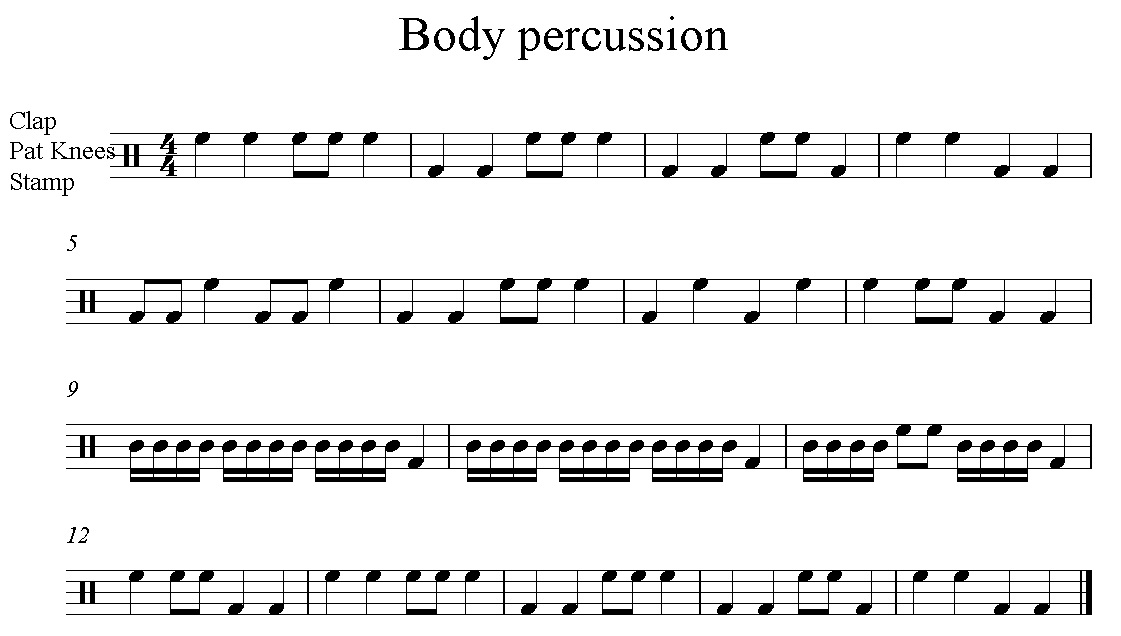
Strategy #3
The last way I incorpate movement into my rehearsals are songs that have accompanying gestures. I like to use these either as a way to wrap up the warm up section of the rehearsal or as a change of pace about 3/4 of the way through rehearsal.
Bim Bum Bitty
Clap on “bim”; snap your fingers on “bum”; pat your thighs on “biddy”. Go faster on each round.

If you would like to see a video demonstration, please check out this link: Bim Bum Biddy Video Demonstration
Dum Dum Song

You can do a variety of movements with the Dum Dum Song and even have your choristers come up with unique gestures. I have used this song and added a new “verse” of gestures each week until we have a long sequence like this video demonstration:
Dum Dum Song Video Demonstration
I’m A-Wide Awake Alert Enthusiastic
This song is to the tune of “If You’re Happy and You Know It”.
Lyrics:
I’m alive, awake, alert, enthusiastic
I’m alive, awake, alert, enthusiastic
I’m alive, awake, alert
I’m alert, awake, alive
I’m alive, awake, alert, enthusiastic
Actions:
Alive / hands on your head
Awake / hands on shoulders
Alert / cross arms over chest
Enthusi- / hands on thighs
-as- / clap
-tic / snap with both hands
Tony Chestnut
This song is great for younger children but I have used it with an intermediate age group and it has worked well.

The following link outlines the accompanying actions:
Aside from these songs, I have also encouraged students to come up with gestures for each phrase of songs that we are working on. This can also be very effective in helping your choristers to memorize the words as each accompanying gesture will help them to remember what they are singing about.
The following songs do not have accompanying gestures but can be a fun addition to your rehearsal. I mean, who doesn’t love pizza? The first song can be sung as a round, and the second song incorporates solo singing. This is a great way to build confidence in your choir and to break the ice for singers who are afraid to share their solo voices.
Pickin’ Up A Pepperoni Pizza
Rico’s Pizza Restaurant




Leave a comment