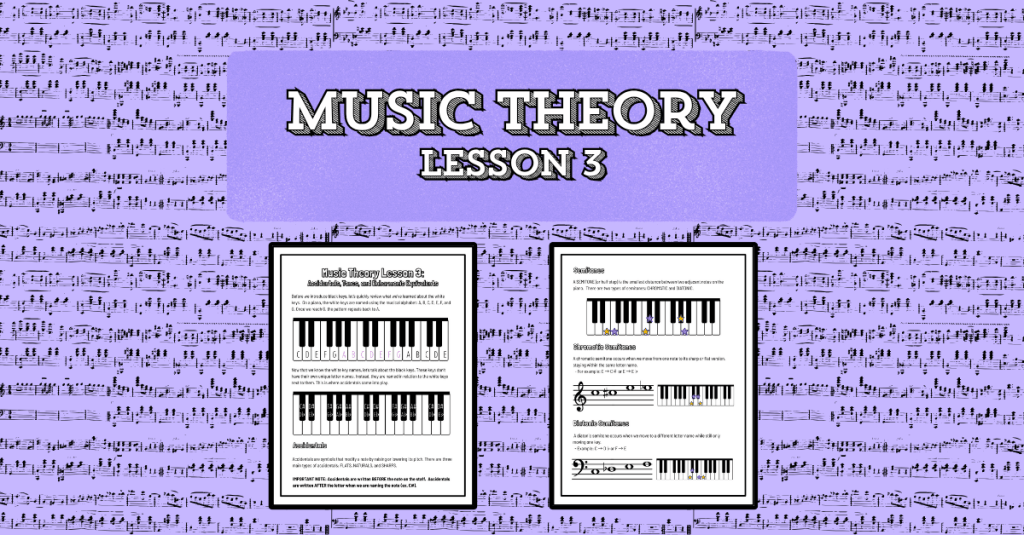
When teaching beginner musicians, accidentals can feel like a maze of sharps, flats, and strange symbols. Lesson 3 in my Music Theory Series is designed to break down these tricky concepts and make them easy for students to understand and apply.
In this lesson, students learn:
• Accidentals: How sharps, flats, and naturals alter notes.
• Semitones and Whole Tones: The building blocks of scales and melodies.
• Enharmonic Equivalents: Why C♯ and D♭ sound the same but look different.
The resource includes a 4-page lesson that explains each concept with clear examples and diagrams, plus 6 pages of worksheets for hands-on practice. An answer key is also included, making it simple to check work and reinforce learning.
Why focus on accidentals and semitones?
These concepts are the foundation of scales, chords, and harmonic understanding. Once students master semitones and whole tones, they can better understand how keys and modes work.
This resource is perfect for music teachers, homeschool families, and private instructors. If you’re looking to make music theory approachable and fun, Lesson 3 is a great addition to your teaching toolkit.
Want to dive deeper?
Check out my (Music Theory Lesson 3) on TpT for ready-to-use worksheets and teaching materials.
Bonus! Pair this lesson with my free YouTube tutorial that walks through each topic step-by-step! Use it to introduce new content, support absent students, or assign for independent review.







Leave a comment