Major scales are one of the most important foundations in music theory. They help students understand key signatures, intervals, harmony, and tonal structure, and they appear constantly in performance repertoire.
However, many students struggle with scales because they are often taught as memorization rather than understanding. When students learn the pattern behind major scales, they can build scales starting on any note and begin to see how scales connect to larger theory concepts.
In this post, I’ll walk through a simple step-by-step approach to teaching major scales, along with activities you can use in class to help students build confidence and accuracy.
If you’re looking for ready-to-use worksheets to support this lesson, you can also check out my Major Scales Theory Lesson and Worksheets here:
👉 Music Theory Lesson 5: The Major Scale
What Is a Major Scale?
A major scale is a sequence of eight notes built using a specific pattern of whole steps and half steps.
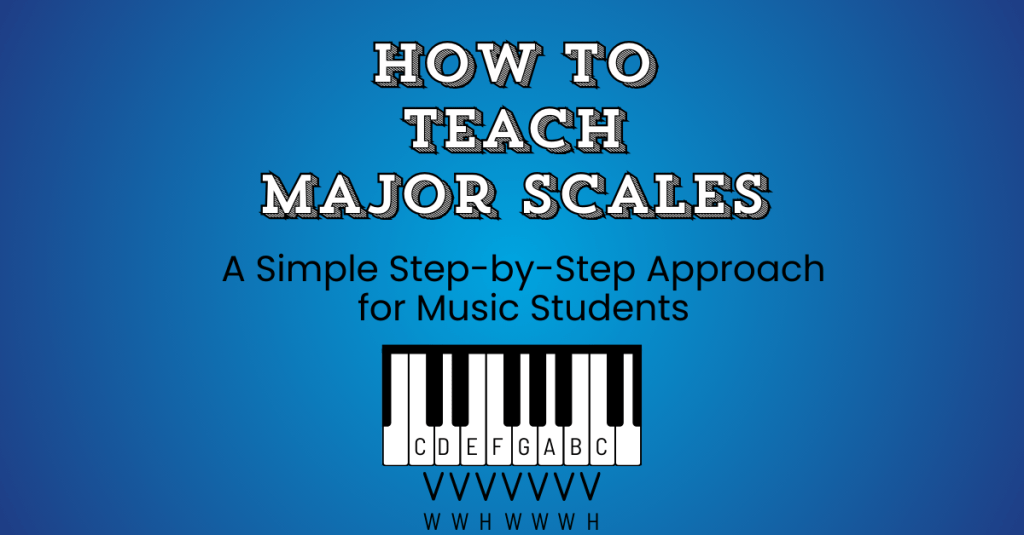
The pattern for a major scale is:
Whole – Whole – Half – Whole – Whole – Whole – Half
or
W – W – H – W – W – W – H
This pattern stays the same no matter what note the scale begins on.
For example:
C Major uses the notes:
C – D – E – F – G – A – B – C
Because this pattern works perfectly using only the white keys of the piano, C major is often the best place to introduce the concept to students.
Step 1: Introduce Whole Steps and Half Steps
Before students can build scales, they must understand how to measure distance between notes.
A half step (semitone) is the smallest distance between two notes in Western music.
Examples:
- E → F
- B → C
- C → C♯
A whole step is equal to two half steps.
Examples:
- C → D
- F → G
- A → B
If your students are new to these concepts, it can be helpful to spend time exploring semitones, whole tones, accidentals, and enharmonic equivalents before introducing scales.
I cover these foundational ideas in detail in this lesson:
👉 Music Theory Lesson 3: Accidentals (Semitones, Whole Tones, and Enharmonic Equivalents)
At this stage, it can be helpful to:
- demonstrate the concept on a piano keyboard
- have students identify half steps between neighboring notes
- practice labeling whole and half steps on the staff
Step 2: Build the C Major Scale
Once students understand whole and half steps, introduce the major scale pattern.
Write the pattern on the board:
W – W – H – W – W – W – H
Then apply it starting on C.
Students should discover:
C → D (whole)
D → E (whole)
E → F (half)
F → G (whole)
G → A (whole)
A → B (whole)
B → C (half)
Because the pattern already works naturally on the white keys, C major contains no sharps or flats.
This is why it is often the best scale to introduce first.
Step 3: Apply the Pattern Starting on Other Notes
Once students understand the pattern, challenge them to build major scales starting on other notes.
For example:
G major
Students begin on G and follow the pattern:
W – W – H – W – W – W – H
They will discover that F♯ is required to maintain the pattern.
This is an important moment because students start to see that:
Sharps and flats exist in scales for a reason — they preserve the interval pattern.
Step 4: Connect Major Scales to Key Signatures
After students build several scales, introduce the concept of key signatures.
Explain that key signatures are simply a shortcut for writing the accidentals that belong to a scale.
For example:
- G major → 1 sharp
- D major → 2 sharps
- A major → 3 sharps
This naturally leads into the circle of fifths, which helps students see how key signatures are organized.
If you plan to teach that concept next, you might also enjoy this lesson:
👉 How to Teach Key Signatures and the Circle of Fifths
Common Problems Students Have With Major Scales
When teaching scales, students often struggle with a few common issues.
Forgetting the step pattern
Students sometimes try to memorize each scale individually rather than remembering the interval formula.
Reinforce the pattern regularly:
W – W – H – W – W – W – H
Confusion about sharps and flats
Students may not understand why accidentals appear.
Remind them that sharps and flats exist to preserve the pattern of whole and half steps.
Difficulty visualizing scales on the staff
Worksheets and written practice can help students:
- build scales
- identify missing notes
- label accidentals correctly
Major Scale Activities for Music Students
Here are a few effective activities you can use when teaching this concept.
Scale Construction
Give students a starting note and have them build the entire scale using the step pattern.
Identify the Incorrect Note
Provide a scale with one incorrect pitch and ask students to find the mistake.
Fill in the Missing Notes
Provide partial scales and have students complete them.
Write the Scale on the Staff
Students write the scale from scratch starting on a given note.
Major Scale Worksheets for Music Class
If you’d like structured practice for students, I created a set of major scale worksheets and activities that guide students through:
- identifying whole and half steps
- building major scales
- writing scales on the staff
- applying the major scale pattern to different starting notes
You can find the full lesson and worksheets here:
👉 Music Theory Lesson 6: The Major Scale
These worksheets work well for:
- middle school music theory
- high school music classes
- choir musicianship lessons
- piano or instrumental theory practice
Why Major Scales Are So Important
Major scales are more than just a technical exercise.
They form the foundation for understanding:
- key signatures
- harmony and chords
- transposition
- sight reading
- tonal relationships in music
Once students understand how scales work, many other theory concepts become much easier to learn.
Final Thoughts
Teaching major scales effectively means helping students understand the structure behind the notes, not just memorize patterns.
When students learn how whole and half steps create the major scale pattern, they gain a skill they can apply to any key in music.
If you’re teaching music theory in the classroom, having a clear sequence of lessons can make a huge difference for students. Concepts like intervals, accidentals, scales, and key signatures all build on one another, and students understand them much more easily when they are taught step by step.
If you’d like ready-to-use materials that follow this progression, you can explore my complete Music Theory Lesson Series, which includes structured lessons, worksheets, and activities designed for middle and high school music students.
👉 Explore the full Music Theory Series here: Lessons With Shana: Music Theory Series
These lessons are designed to help students gradually build understanding of essential musicianship skills, including the grand staff, piano keyboard, time signatures, scales, key signatures, intervals, and more.







Leave a comment