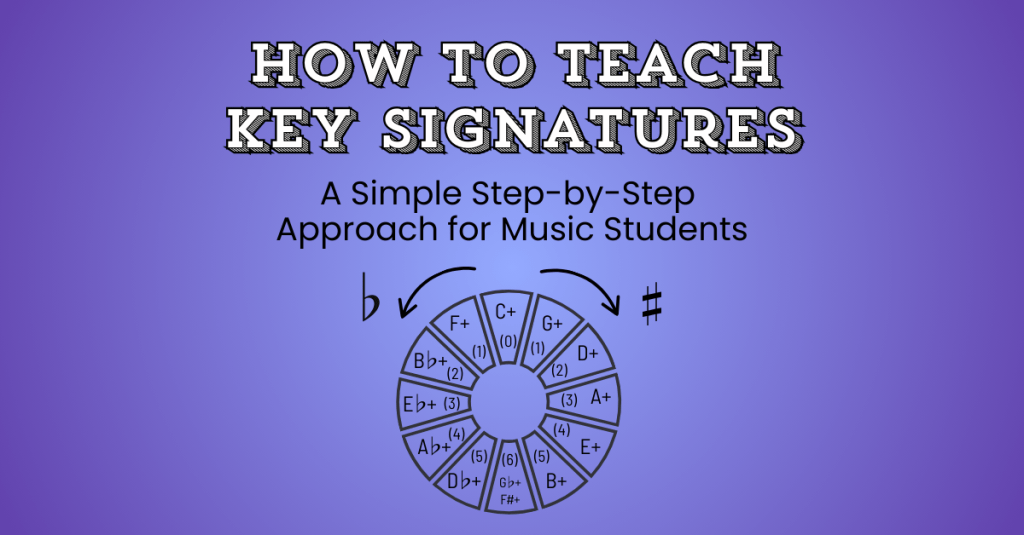
For many music students, key signatures feel like something they simply have to memorize. Students might remember that G major has one sharp or that F major has one flat, but they often don’t understand why those accidentals appear.
The circle of fifths helps students see the logic behind key signatures. Instead of memorizing random information, they begin to understand how keys are connected and why sharps and flats appear in a predictable order.
In this guide, I’ll walk through a simple approach to teaching key signatures and the circle of fifths that helps students move from memorization to real understanding.
What Is the Circle of Fifths?
The circle of fifths is a visual diagram that shows the relationships between musical keys.
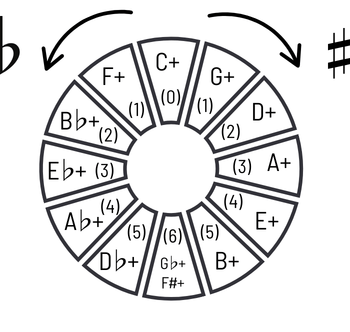
Each key is separated by an interval of a fifth. Moving clockwise around the circle adds sharps, while moving counterclockwise adds flats.
At the top of the circle is C major, which contains no sharps or flats.
Moving clockwise:
C → G → D → A → E → B → F♯ → C♯
Each step adds one sharp to the key signature.
Moving counterclockwise:
C → F → B♭ → E♭ → A♭ → D♭ → G♭ → C♭
Each step adds one flat.
Once students see this pattern, key signatures become much easier to understand and remember.
Why the Circle of Fifths Makes Key Signatures Easier
Students often struggle with key signatures because they try to memorize them individually.
The circle of fifths shows students that key signatures follow a consistent pattern.
Sharps always appear in the same order
F – C – G – D – A – E – B
Flats also follow a predictable order
B – E – A – D – G – C – F
When students understand this pattern, they no longer need to memorize each key signature separately. Instead, they can build them logically using the circle of fifths.
How I Teach the Circle of Fifths Step-by-Step
Here is a simple sequence that works well for middle school and high school music students.
Step 1: Start with C Major
Begin with the key of C major, which has no sharps or flats.
This makes it a natural starting point for understanding the system.
Review the C major scale with students and remind them that this key contains only natural notes.
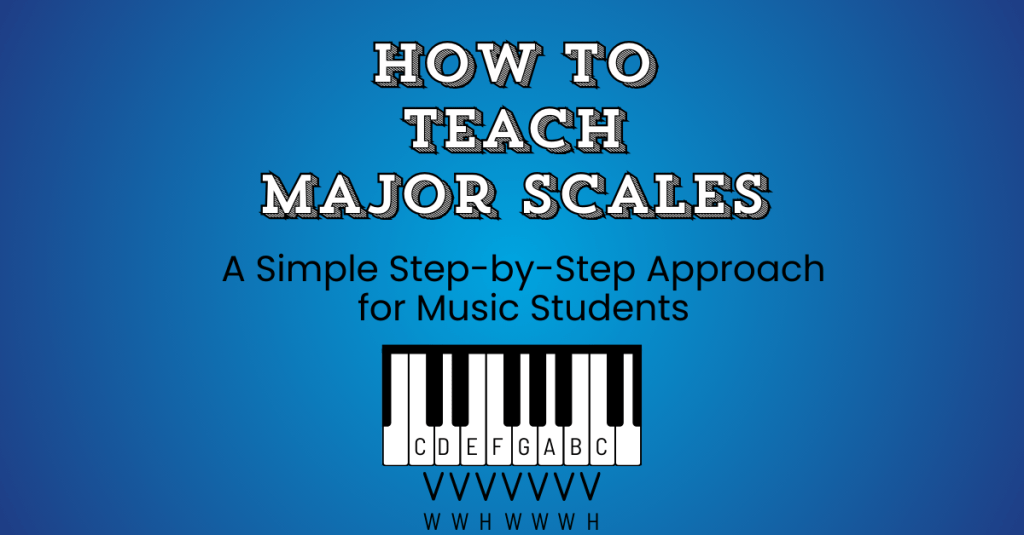
If your students need a refresher on building major scales, you can also explore this lesson:
👉 How to Teach Major Scales (Step-by-Step Guide)
Step 2: Move Up a Fifth
From C, move up a fifth to G major.
Ask students to build the G major scale using the major scale pattern.
They will discover that F♯ is required to maintain the correct pattern of whole and half steps.
This is a powerful moment because students see that:
Key signatures exist because the scale pattern requires certain accidentals.
Step 3: Continue the Pattern
Next, move up another fifth to D major.
Students will discover that D major requires:
F♯ and C♯
Continue building scales in this way so students see the pattern:
G major → 1 sharp
D major → 2 sharps
A major → 3 sharps
E major → 4 sharps
At this point, many students begin to notice that each new key adds one more sharp.
Step 4: Explore the Flat Side
Once students understand the sharp side, return to C major and move down a fifth.
This brings you to F major.
Students will discover that F major contains B♭.
Continue the pattern:
F major → 1 flat
B♭ major → 2 flats
E♭ major → 3 flats
A♭ major → 4 flats
This helps students see that the system works in both directions.
Activities for Practicing Key Signatures
Once students understand the concept, give them opportunities to apply their knowledge.
Here are a few activities that work well in music class.
Complete the Circle of Fifths
Provide a partially completed circle and have students fill in the missing keys.
Identify the Key Signature
Show students a staff with accidentals and ask them to identify the correct key.
Write the Key Signature
Give students the name of a key and have them write the correct sharps or flats on the staff.
Build the Scale
Students write the full major scale that corresponds to the key signature.
Worksheets for Teaching Key Signatures and the Circle of Fifths
If you’re looking for ready-to-use activities, I created a structured set of worksheets designed to help students practice:
- identifying key signatures
- completing the circle of fifths
- applying the order of sharps and flats
- connecting key signatures to major scales
You can explore the full lesson and worksheet set here:
👉 Music Theory Lesson 6 BUNDLE
These activities work well for:
- middle school music classes
- high school music theory
- choir musicianship lessons
- piano or instrumental theory instruction
Explore the Full Music Theory Lesson Series
Key signatures and the circle of fifths are part of a larger sequence of music theory concepts that students gradually build over time.
If you’re looking for a structured progression of lessons that covers topics like intervals, accidentals, scales, key signatures, and more, you can explore my complete Music Theory Lesson Series here:
The lessons are designed to help students build a strong foundation in musicianship while developing confidence in reading and understanding music.
Final Thoughts
The circle of fifths transforms key signatures from something students must memorize into something they can actually understand.
By helping students see the pattern behind sharps and flats, you give them a framework that supports many other areas of music learning, including scales, harmony, and transposition.
With consistent practice and clear explanations, students quickly realize that key signatures are not random at all — they follow a beautifully organized system.






Leave a comment