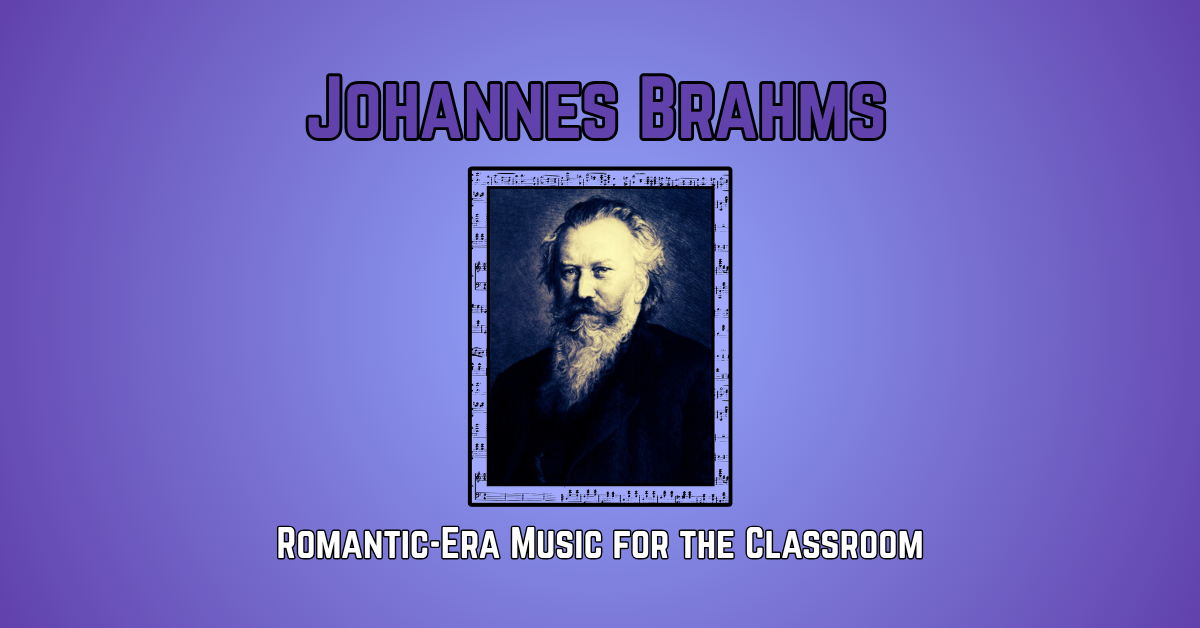
Johannes Brahms offers music teachers an ideal way to introduce the Romantic era at the beginning of the school year. His music combines powerful emotion with carefully organized musical forms, giving students an accessible connection between the Classical and Romantic periods.
Many students will already recognize at least one Brahms melody, even if they cannot identify its composer. The familiar tune commonly known as Brahms’ Lullaby provides a gentle entry point, while Hungarian Dance No. 5 introduces a completely different side of his musical personality.
Add his symphonies, piano works, chamber music, and remarkable choral repertoire, and Brahms becomes an excellent composer for a back-to-school listening unit.
Who Was Johannes Brahms?
Johannes Brahms was born in Hamburg, Germany, in 1833. He demonstrated musical talent at an early age and became an accomplished pianist as well as a composer.
Brahms eventually settled in Vienna, where he developed a reputation as one of the leading musicians of the nineteenth century. His music includes symphonies, concertos, chamber works, solo piano music, songs, and large-scale choral compositions.
Unlike some Romantic composers who rejected older musical conventions, Brahms respected the forms and compositional techniques associated with earlier composers. He combined that structural precision with rich harmony, memorable melodies, rhythmic complexity, and intense emotional expression.
This balance makes Brahms especially useful when helping students compare the Classical and Romantic eras.
Brahms and the Romantic Era
Romantic-era composers often used music to explore emotion, imagination, individuality, nature, literature, and national identity. Orchestras expanded, harmonies became richer, and composers experimented with greater contrasts in mood, tempo, and dynamics.
Brahms participated fully in this musical world, but he also maintained a strong connection to Classical forms. His music often uses familiar structures while filling them with Romantic harmony and expression.
Students can listen for several characteristics in Brahms’ music:
- Rich, full harmonies
- Expressive melodies
- Dramatic dynamic contrasts
- Changes in tempo and musical energy
- Dense musical textures
- Carefully developed themes
- Traditional forms shaped by Romantic expression
This combination challenges the idea that musical eras exist in completely separate boxes. Brahms shows students how composers can preserve earlier traditions while creating an individual musical voice.
Begin With Brahms’ Lullaby
The melody widely known as Brahms’ Lullaby comes from his “Wiegenlied,” Op. 49, No. 4, a song for voice and piano. Its calm melody and rocking accompaniment have made it one of the world’s most recognizable lullabies.
Because many students have heard the tune before, it creates an immediate connection. Ask students whether they recognize it before revealing the composer or title.
After listening, discuss:
- What makes the music sound peaceful?
- How does the accompaniment create a rocking feeling?
- What melodic or rhythmic patterns repeat?
- How would the effect change at a faster tempo?
- Which musical choices make the piece appropriate as a lullaby?
- What emotions or images does the music suggest?
This listening activity works particularly well during the first weeks of school because it allows students to discuss musical elements without requiring extensive prior knowledge.
You may recognize this melody before you recognize its title. Listen to Brahms’ famous Wiegenlied and consider how melody, rhythm, tempo, and accompaniment work together to create its soothing character.
Discover a Different Brahms in Hungarian Dance No. 5
After the calm character of the lullaby, Hungarian Dance No. 5 provides a dramatic contrast.
Brahms originally published his Hungarian Dances as piano duets, although they later appeared in many arrangements. No. 5 became the most famous of the collection and remains one of his most recognizable works.
Its energetic rhythms, sudden contrasts, and changing pace make it an engaging selection for students. The piece also encourages active listening because students must respond as the musical energy shifts.
Before listening, ask students to predict how a dance might differ from a lullaby. Then encourage them to listen for:
- Changes in tempo
- Repeated rhythmic ideas
- Sudden dynamic contrasts
- Changes in mood and energy
- Musical phrases that accelerate or slow down
- The relationship between rhythm and movement
Brahms was capable of writing music with completely different moods and levels of energy. After the gentle character of his lullaby, listen to the lively rhythms and dramatic tempo changes in Hungarian Dance No. 5.
Try a Rhythm Movement Game
Movement can help students experience musical changes before they have the vocabulary to describe them.
While listening to Hungarian Dance No. 5, ask students to clap, tap, or step with the beat. Their movements should respond to changes in tempo and musical energy.
Next, place students in pairs or small groups. Ask them to create simple movements that reflect the piece’s energetic rhythms and changing pace.
Afterward, discuss:
- Which musical changes affected your movements?
- When did the beat feel stable?
- Where did the tempo appear to shift?
- How did Brahms create contrast?
- Which parts of the music returned?
- Did everyone interpret the music in the same way?
This activity works well at the beginning of the year because it combines listening, collaboration, and movement. It also gives teachers an informal opportunity to observe students’ beat awareness and comfort responding to music.
Explore Brahms’ Choral Music
Choir students should know Brahms for much more than his famous lullaby. Choral music played an important role throughout his career, and his vocal writing ranges from smaller songs and part-songs to large-scale works.
His most famous choral composition is A German Requiem. Unlike the traditional Latin requiem Mass, Brahms selected German biblical texts for the work. Its focus is often described as consolation for the living rather than prayer for the dead.
The work gives students an opportunity to explore:
- Text setting
- Large-scale choral form
- The relationship between voices and orchestra
- Musical contrast
- Harmonic tension and resolution
- How composers communicate grief, comfort, and hope
- The role of sacred texts in concert music
You do not need to present the entire work at once. Choose a short excerpt and ask students to describe the relationship between the text, harmony, dynamics, and vocal texture.
Brahms’ choral music reveals another side of his expressive style. In A German Requiem, he uses voices, orchestra, harmony, and text to move between sorrow, reflection, reassurance, and hope.
Compare Brahms With Beethoven
Brahms was frequently associated with the musical legacy of Beethoven. Both composers wrote major symphonies, concertos, chamber music, piano works, and other large-scale compositions.
This connection provides a useful comparison activity. Play a short excerpt by each composer and ask students to identify similarities and differences in:
- Instrumentation
- Musical form
- Harmony
- Dynamics
- Texture
- Emotional character
- Development of musical ideas
Students do not need to identify every feature correctly. The goal is to help them support their observations with evidence from the music.
You might ask:
How does Brahms preserve Classical structure while creating a distinctly Romantic sound?
That question can guide discussion, written reflection, or a short exit ticket.
Use Brahms for Back-to-School Listening
A Brahms lesson can help establish your expectations for listening activities at the beginning of the year.
Teach students how to:
- Listen silently and attentively
- Identify specific musical elements
- Describe music using appropriate vocabulary
- Explain an answer with musical evidence
- Respond physically to rhythm and tempo
- Compare contrasting compositions
- Discuss different interpretations respectfully
Begin with the familiar lullaby, move into the energetic Hungarian Dance No. 5, and finish with an excerpt from his choral repertoire. This sequence introduces students to three contrasting sides of one composer while establishing a repeatable structure for future Composer of the Month lessons.
A Ready-to-Use Johannes Brahms Music Lesson
My Johannes Brahms Composer of the Month Resource provides a simple way to introduce Brahms without building an entire lesson from scratch.
The resource includes:
- Johannes Brahms portrait posters
- Informational biography posters
- Colour and black-and-white versions
- A listening activity featuring Hungarian Dance No. 5
- A rhythm movement game
- A ten-question comprehension quiz
- A complete answer key
Students learn about Brahms’ life, his place in the Romantic era, his connection to Classical form, and important genres within his body of work. The listening activity then brings those ideas into an active musical experience.
Want to introduce Johannes Brahms without spending your planning time creating posters, listening prompts, and assessment questions? This ready-to-use Composer of the Month resource combines composer history, active listening, movement, and comprehension in one classroom-friendly lesson.

Continue the Composer of the Month Series
Brahms can become part of a broader Composer of the Month routine that exposes students to different eras, genres, and musical styles throughout the school year.
A consistent monthly structure might include:
- Introduce the composer with a portrait and biography.
- Discuss the composer’s historical period and musical style.
- Listen to one featured composition.
- Complete an interactive listening activity.
- Compare the music with another composer or genre.
- Assess understanding with a short quiz or written response.
Repeating this structure helps students develop familiarity with music history while gradually strengthening their listening vocabulary.
If you would like to continue this routine throughout the year, the complete Composer of the Month series provides coordinated composer posters, biographies, listening activities, and assessments for twelve influential composers.

Bring Brahms Into Your Music Classroom
Brahms offers far more than one famous lullaby. His music can be gentle, energetic, reflective, dramatic, carefully structured, and deeply expressive.
That range makes him an excellent choice for a September composer study. Students can begin with a melody they may already know, respond physically to the changing energy of Hungarian Dance No. 5, and discover the depth of Brahms’ choral writing.
In one composer study, students encounter the Romantic era, Classical influence, active listening, movement, music history, and choral music—making Brahms a strong beginning to a full year of musical discovery.
Looking for more Music Education resources?
Explore my whole Teachers Pay Teachers store here.



Leave a Reply