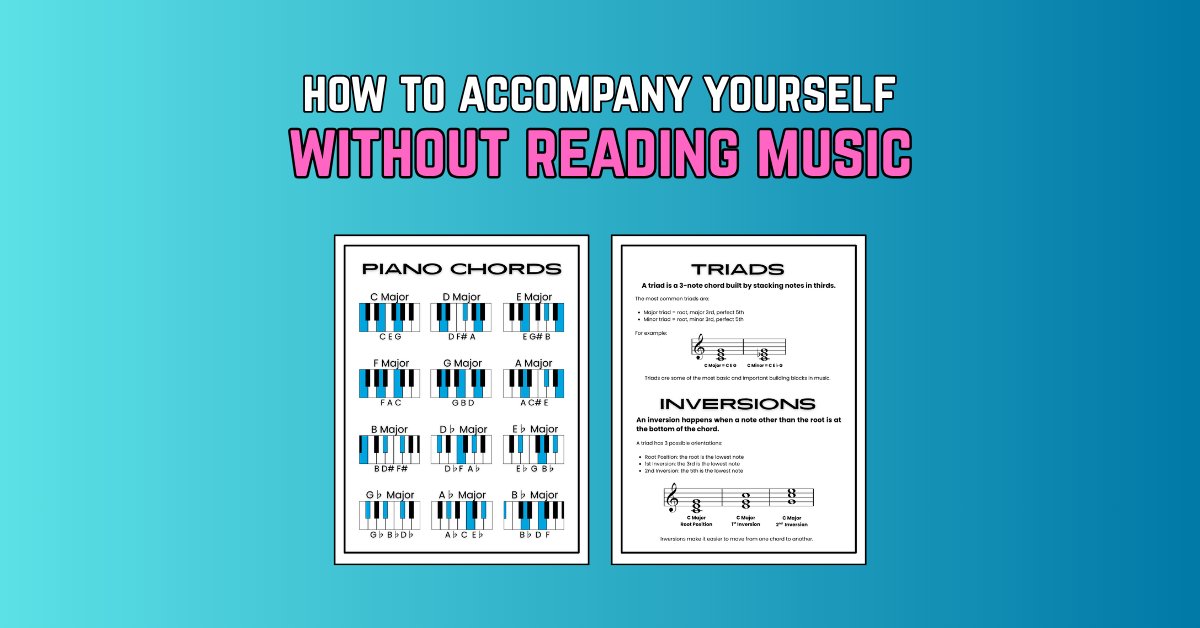
If you have ever wanted to sit down at the piano and accompany yourself while singing, but had no idea where to start, you are not alone.
A lot of singers assume they need years of piano lessons or the ability to read sheet music before they can accompany themselves.
You don’t.
With a basic understanding of chords, chord charts, and inversions, you can start building simple accompaniments for thousands of songs.
In this post, I’ll walk you through the foundational skills you need to get started.
You can also download my free Piano Chord Guide here:
And if you prefer to learn by watching and listening, you can follow along with the full lesson here:
Start With Chords
The foundation of self-accompaniment is understanding chords.
For this kind of playing, one of the most important chord types to understand is the triad.
A triad is simply a three-note chord.
The two most common types you’ll encounter are major and minor chords.
For example:
C major = C–E–G
A major chord tends to have a brighter, more stable sound.
A minor chord uses a slightly different pattern.
For example:
A minor = A–C–E
Minor chords tend to have a darker or more emotional sound.
Once you can quickly identify and play basic major and minor triads, chord charts become much easier to understand.
Learn How Chords Are Built
One of the easiest ways to build chords at the piano is to think in semitones, also called half steps.
A semitone is the distance from one piano key to the very next key, whether that key is black or white.
To build a major triad, use this pattern:
4 semitones + 3 semitones
For example, starting on C:
C → E = 4 semitones
E → G = 3 semitones
That gives you:
C–E–G
To build a minor triad, reverse the pattern:
3 semitones + 4 semitones
For example, starting on A:
A → C = 3 semitones
C → E = 4 semitones
That gives you:
A–C–E
This means you do not have to memorize every chord immediately. You can use the pattern to work them out as you learn.
How to Read a Basic Chord Chart
Once you understand basic chords, you can start using chord charts.
Instead of showing you every note on a musical staff, a chord chart simply tells you which chord to play.
For example, you might see:
C | G | Am | F
This tells you to play:
C major
G major
A minor
F major
That sequence is called a chord progression.
Chord charts are one of the easiest ways for singers to begin accompanying themselves because you can focus on chord shapes rather than reading every individual note.
Start With Simple Block Chords
When you are just getting started, do not worry about fancy accompaniment patterns.
Simply play each chord and hold it.
For example:
C | G | Am | F
You might hold each chord for four beats before changing to the next one.
That is already accompaniment.
The goal at this stage is simply to become comfortable moving from one chord to another.
Once your hands begin to recognize those chord shapes automatically, adding your voice becomes much easier.
Learn Inversions for Smoother Chord Changes
Inversions are one of the biggest game changers when it comes to accompanying yourself.
A chord is in root position when the root is the lowest note.
For example, C major in root position is:
C–E–G
But those same notes can be rearranged:
E–G–C
or
G–C–E
These are called inversions.
The chord is still C major. The notes are simply arranged differently.
Why does this matter?
If you always play every chord in root position, your hand often has to jump around the keyboard.
Using inversions allows you to choose the version of the next chord that is closest to where your hand already is.
That makes your chord progressions sound smoother and makes them easier to play.
A helpful rule is:
Look for the closest version of the next chord.
You do not need to memorize every inversion name before you start using them. Simply get comfortable rearranging the notes of each chord and finding the shape that requires the least movement.
Keep the Piano Part Simple While You Sing
When you first start combining singing and playing, simpler is better.
If the piano part requires all of your concentration, you will not have much attention left for your voice.
Start with simple chords.
Practice the chord progression by itself until it feels comfortable.
Then try speaking the lyrics while you play.
Next, try humming the melody.
Finally, add your full singing voice.
This gradual approach makes singing and playing feel much more manageable.
Remember: The Piano Supports the Voice
When you accompany yourself, the piano does not need to be complicated.
Its job is to provide harmony, rhythm, and support for your singing.
A simple accompaniment that allows you to sing freely will almost always be more effective than a complicated piano part that distracts from your voice.
As your skills improve, you can begin experimenting with bass notes, octaves, broken chords, rhythmic patterns, and more advanced accompaniment styles.
But chords are the foundation.
Download the Free Piano Chord Guide
If you are learning chords for the first time, having a visual reference beside you at the piano can make things much easier.
That is why I created a free Piano Chord Guide to go along with this lesson.
Use it to practice major and minor chord shapes, review common chords, and begin building confidence at the keyboard.
Watch the Full Piano Lesson
Want to see all of this demonstrated at the keyboard?
In my full YouTube lesson, I walk you through:
- What a chord is
- How to build major and minor triads
- How to read a basic chord chart
- How to play a simple chord progression
- What inversions are
- How to use inversions to make your chord changes smoother
WATCH: How to Accompany Yourself on Piano Without Reading Music
Keep Building Your Skills
Once you are comfortable with chords and inversions, you can begin exploring more advanced accompaniment patterns.
You can also check out my other piano, singing, music theory, and musicianship lessons on YouTube.
If you are working on your voice alongside your piano skills, I also have guided vocal workouts that can help you build strength, coordination, range, and confidence.
Final Thoughts
Learning to accompany yourself on piano does not have to begin with complicated sheet music or advanced technique.
Start with chords.
Learn how to read simple chord charts.
Use inversions to make your progressions smoother.
Then gradually begin adding your voice.
Even a simple accompaniment can sound musical and effective when it is steady, confident, and supports your singing.
Grab the free Piano Chord Guide, watch the full lesson, and start playing.
What to Learn Next
Once you’re comfortable finding chords and moving between them smoothly, you can start developing your piano technique so playing feels easier and more natural.
Build Your Piano Technique
If you want to strengthen your fingers, improve coordination, and become more comfortable at the keyboard, check out my piano technique videos on YouTube. These exercises are a great next step if you’re building your piano skills from the ground up.
Want More Structured Music Theory Practice?
If you want to go deeper into the theory behind what you’re playing, you can also find my music theory resources on Teachers Pay Teachers.
They’re designed to build foundational skills step by step, including note reading, scales, key signatures, rhythm, and more.
And don’t forget to grab your free Piano Chord Guide if you haven’t already!




Leave a Reply