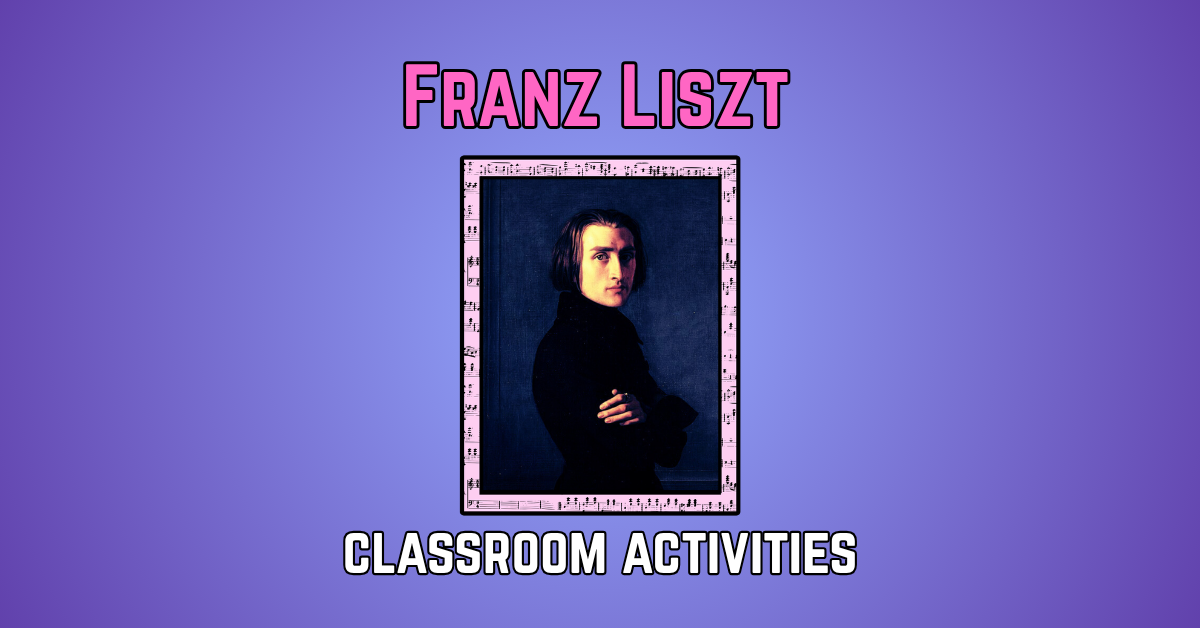
These Franz Liszt classroom activities bring virtuosity, dramatic storytelling, and Romantic-era expression into the music room. Known for his dazzling piano performances and technically demanding compositions, Liszt created music filled with sudden contrasts, powerful emotions, and theatrical energy.
That makes October an ideal time to introduce him. Students can explore the excitement of Hungarian Rhapsody No. 2, create a dramatic sound story, and discover how one pianist became a nineteenth-century musical superstar.
Who Was Franz Liszt?
Franz Liszt was born in 1811 in the Kingdom of Hungary. His birthplace now lies within Austria, but Liszt maintained a strong Hungarian identity throughout his life.
Liszt demonstrated exceptional musical ability as a child. He began performing publicly at a young age and eventually became one of Europe’s most celebrated pianists.
Audiences responded intensely to his concerts. His commanding stage presence, technical brilliance, and emotionally charged performances helped transform the public image of the concert pianist.
Liszt also composed piano music, orchestral works, symphonic poems, songs, choral music, and transcriptions. In addition, he supported other musicians and taught many younger pianists. Later in his life, he received minor orders in the Catholic Church and became widely known as Abbé Liszt. The Liszt Ferenc Memorial Museum offers a detailed overview of his life and work.
What Is Musical Virtuosity?
The word virtuosity describes an exceptional level of technical skill. A virtuoso performer can execute music that demands extraordinary speed, control, precision, expression, and physical coordination.
Liszt became famous for piano techniques that appeared almost impossible to audiences of his time. His music often features:
- Rapid scales and arpeggios
- Powerful octaves
- Large leaps across the keyboard
- Quick repeated notes
- Dense chords
- Crossing hands
- Sudden dynamic contrasts
- Multiple musical layers
- Brilliant, fast passages
- Expressive melodies surrounded by elaborate accompaniment
However, virtuosity involves more than playing quickly. The performer must use technical skill to communicate the character and emotion of the music.
Ask students:
- Can music be technically impressive without being expressive?
- What makes a performance feel dramatic?
- Does faster always mean more difficult?
- How can a pianist make one instrument sound orchestral?
- Why might audiences enjoy watching a virtuoso performer?
These questions encourage students to consider the connection between technical ability, artistic expression, and performance.
Liszt: The Romantic Era’s Musical Superstar
Modern students understand celebrity culture. They know that certain performers attract devoted fans, command attention, and develop recognizable public identities.
Liszt offers a fascinating nineteenth-century comparison.
His concerts attracted enormous public interest, and his admirers followed his performances enthusiastically. The excitement surrounding him became so intense that the poet Heinrich Heine famously used the term Lisztomania to describe it.
Liszt also helped establish the solo piano recital as a major concert experience. Instead of serving only as one performer within a larger program, he could command the stage alone and create an entire evening of music.
Discussion opportunity:
Ask students to compare Liszt with a modern musical superstar.
- How do performers create a public identity?
- Why do audiences become fascinated with certain musicians?
- How might nineteenth-century celebrity differ from celebrity today?
- What qualities make a live performance memorable?
- How does stage presence affect an audience’s experience?
This comparison gives students a familiar path into Romantic-era music history.
Romantic Music and Dramatic Expression
Romantic composers often explored powerful emotions, vivid imagery, literature, nature, folklore, fantasy, and individual expression.
Liszt embraced those possibilities. His music can move rapidly between mystery, lyricism, tension, humour, grandeur, and explosive excitement.
Students can listen for Romantic characteristics such as:
- Extreme dynamic contrasts
- Flexible tempo
- Rich harmony
- Emotional melodies
- Sudden shifts in mood
- Programmatic ideas
- Expanded forms
- National influences
- Technically demanding performance
- Music inspired by stories, places, art, or literature
Rather than discussing the Romantic era only through definitions, allow students to hear how composers used musical elements to create an emotional journey.
Listen to Hungarian Rhapsody No. 2
Hungarian Rhapsody No. 2 is one of Liszt’s best-known piano compositions. Its memorable themes, dramatic contrasts, and dazzling final passages make it an engaging introduction to his music.
The piece begins with a slower, more serious section before moving into increasingly energetic music. Listeners encounter changing moods, shifting tempos, rhythmic excitement, and a highly virtuosic conclusion.
Before playing it, ask students to listen for:
- Changes in tempo
- Contrasting dynamics
- Shifts in mood
- Repeated themes
- Moments of tension and release
- Changes in register
- Passages that sound improvised
- Techniques that demonstrate virtuosity
The composition has also appeared in animated films and popular culture, so some students may recognize sections without knowing the title or composer.
Listen as Liszt transforms the piano into an entire dramatic world. Notice how Hungarian Rhapsody No. 2 moves between serious, playful, mysterious, and intensely energetic sections before reaching its spectacular conclusion.
Turn the Music Into a Dramatic Sound Story
Your students do not need advanced music-theory knowledge to recognize that the character of Hungarian Rhapsody No. 2 keeps changing.
After listening, invite them to create a short scene, comic strip, or storyboard inspired by the music.
Their stories might include:
- A mysterious visitor
- A character entering an unfamiliar place
- A chase or escape
- A magical object
- A dramatic disagreement
- An unexpected transformation
- A mischievous character
- A celebration that becomes increasingly chaotic
- A suspenseful adventure
- A series of surprising events
Encourage students to connect specific musical changes to events in their stories. A quiet passage might introduce a character, while a sudden dynamic shift could signal danger or surprise. Faster music might accompany a chase, and a returning theme could represent the return of a person, place, or idea.
Students should use musical evidence rather than creating a story with no connection to what they hear.
Ask them to consider:
- What kind of character matches the opening?
- Where does the central conflict begin?
- Which musical moment creates the greatest suspense?
- How does the story change when the tempo increases?
- What event matches the loudest or most dramatic passage?
- How should the final section resolve the story?
Make It a Halloween-Season Music Activity
Although Hungarian Rhapsody No. 2 is not specifically a Halloween composition, its theatrical contrasts make it easy to connect with October storytelling.
Invite students to give their dramatic sound stories an optional seasonal theme. They might create a mysterious mansion, magical adventure, comic monster, strange carnival, enchanted piano, or mischievous ghost story.
Keep the prompt broad enough that students can choose something dramatic without making the activity frightening. The musical goal remains the same: students must connect changes in mood, volume, tempo, and character to their creative decisions.
Optional extension: Display the completed storyboards around the music room as an October listening gallery.
Students can walk through the gallery and compare how classmates interpreted the same composition. This reinforces the idea that listeners may imagine different stories while still identifying the same musical evidence.
Want to continue exploring dramatic and mysterious music throughout October? These Spooky Music Listening Journal Ideas for October Music Lessons help students respond to seasonal listening selections using musical vocabulary, creative thinking, and focused reflection.
Explore Liszt’s Darker Music
For a stronger Halloween-season connection, introduce a short excerpt from another dramatic Liszt composition.
Possible selections include:
- Totentanz
- Mephisto Waltz No. 1
- Funérailles
- Après une lecture du Dante
- Nuages gris
These pieces explore different kinds of musical darkness. Some sound energetic and supernatural, while others feel sombre, unsettling, or mysterious.
Ask students to compare one excerpt with Hungarian Rhapsody No. 2:
- Which piece sounds more mysterious?
- How does Liszt create tension?
- What role do dynamics play?
- Does the music create fear, excitement, sadness, or suspense?
- Which piano techniques contribute to the atmosphere?
- How does the mood change across the excerpt?
This comparison expands the Halloween theme without turning the entire lesson into a novelty activity.
What Is a Symphonic Poem?
Liszt contributed significantly to the development of the symphonic poem, an orchestral composition inspired by an extra-musical idea such as a story, poem, image, historical event, or landscape.
Instead of following a traditional multi-movement symphonic structure, a symphonic poem usually develops its ideas within one continuous movement.
The genre connects naturally to the dramatic sound-story activity. In both cases, students explore how instrumental music can suggest characters, images, events, or emotions without using spoken words.
Ask students:
If you wrote a symphonic poem, what story, place, artwork, or idea would inspire it?
Students can create a title and brief program note for an imaginary symphonic poem. They could also choose instruments, tempos, dynamics, and musical textures that would support their idea.
Compare Liszt and Brahms
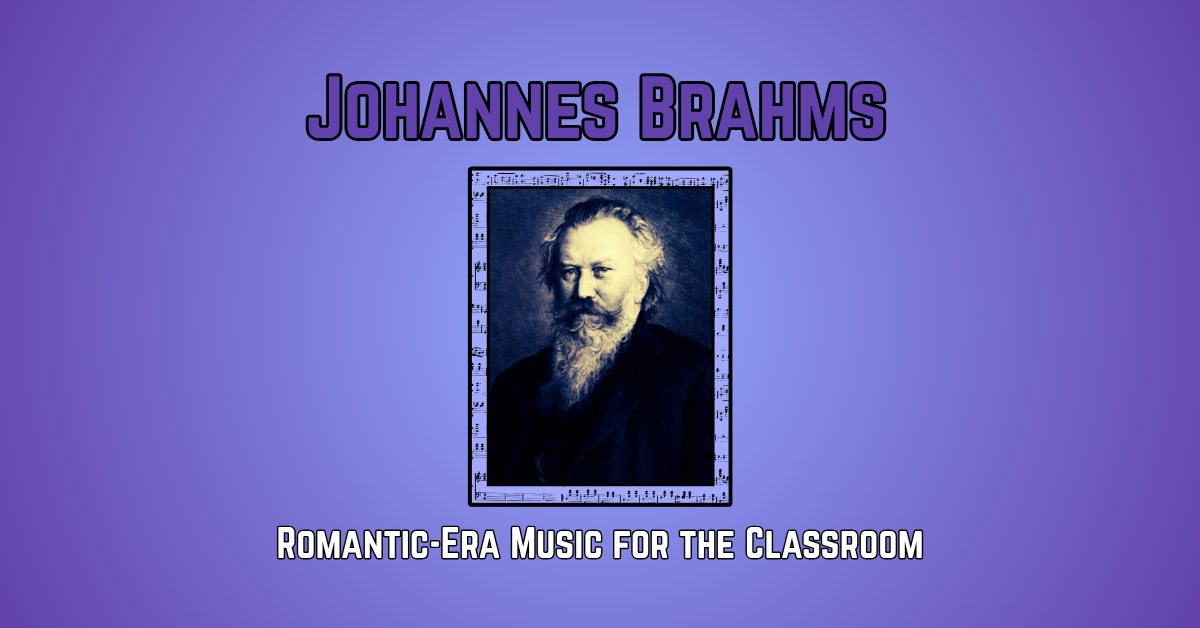
Liszt and Johannes Brahms both belong to the Romantic era, yet their musical identities offer an interesting contrast.
Brahms often combined Romantic emotion with established Classical forms. Liszt became closely associated with programmatic music, innovation, dramatic performance, and the symphonic poem.
Play short excerpts by both composers and ask students to compare:
- Musical structure
- Emotional intensity
- Use of the piano
- Tempo and rhythmic flexibility
- Dynamic contrast
- Programmatic ideas
- Performance style
- The role of virtuosity
This activity helps students understand that composers from the same period did not all approach music in the same way.
Liszt and Brahms reveal two distinctive approaches to Romantic-era music. Compare Liszt’s theatrical virtuosity with Brahms’ balance of rich emotion and carefully crafted musical structure.
Read Johannes Brahms: Lullabies, Choral Works, and Romantic-Era Listening
Teach Students How to Describe Dramatic Music
Students often respond to unfamiliar music with general statements such as “It sounds scary,” “It is dramatic,” or “It gets crazy.”
Accept those initial reactions, then ask students to explain what they heard.
Useful musical vocabulary might include:
- Accelerando
- Ritardando
- Crescendo
- Diminuendo
- Forte
- Piano
- Tempo
- Dynamics
- Articulation
- Register
- Texture
- Theme
- Contrast
- Tension
- Resolution
- Virtuosity
Encourage students to expand their observations:
“The music sounds dramatic because the tempo accelerates, the dynamics become louder, and the pianist plays rapid passages across a wide register.”
That sentence demonstrates both personal interpretation and musical evidence.
Connect Liszt to Piano Technique
A Liszt lesson also creates an opportunity to discuss the physical and technical demands of piano performance.
Ask students to observe:
- Hand movement across the keyboard
- Changes in posture
- How the performer prepares for large leaps
- When the hands cross
- The balance between melody and accompaniment
- How the pianist creates different dynamic levels
- The use of pedals
- How the performer shapes long phrases
- The amount of physical control required
Students should understand that an exciting performance does not come from uncontrolled movement. Virtuoso playing depends on careful preparation, efficient technique, listening, and thousands of deliberate decisions.
Liszt’s music offers a striking example of how technique supports expression. Explore additional piano-teaching tools and resources that help students develop coordination, musical understanding, and confident performance habits.
A Ready-to-Use Franz Liszt Music Lesson
My Franz Liszt Composer of the Month Resource introduces students to Liszt’s life, Romantic style, piano virtuosity, and musical influence.
The resource includes:
- Franz Liszt portrait posters
- Informational biography posters
- Colour and black-and-white options
- A listening activity for Hungarian Rhapsody No. 2
- A dramatic sound-story prompt
- Options for a short scene, comic strip, or storyboard
- A ten-question comprehension quiz
- A complete answer key
Students learn about Liszt’s Hungarian identity, public performances, technically challenging music, symphonic poems, and later work as a teacher and musical mentor.
Bring Liszt’s dramatic music into your classroom without creating an entire lesson from scratch. This ready-to-use Composer of the Month resource combines music history, focused listening, creative storytelling, and assessment in one classroom-friendly activity.

Continue Your Composer of the Month Routine
A consistent Composer of the Month routine helps students gradually develop their knowledge of musical periods, important composers, and active-listening vocabulary.
Each month, students can:
- Meet the composer through a portrait and biography.
- Identify the composer’s musical era.
- Learn important stylistic characteristics.
- Listen to a featured composition.
- Complete a creative or interactive response.
- Demonstrate their understanding through discussion or assessment.
By October, students may already understand the routine. That familiarity allows them to focus more attention on the music itself.
Continue building music-history and listening skills throughout the year with the complete Composer of the Month series. Each resource includes coordinated composer information, a featured listening activity, and an assessment to create a consistent classroom routine.

Bring Romantic-Era Drama Into Your Classroom
Franz Liszt provides an irresistible combination of musical drama, technical brilliance, storytelling, and nineteenth-century celebrity.
Students can hear virtuosity in action, explore how instrumental music suggests a story, and transform Hungarian Rhapsody No. 2 into an original scene or storyboard. Optional selections such as Totentanz or the Mephisto Waltz deepen the October atmosphere.
Most importantly, students learn to move beyond simply calling music “dramatic.” They begin identifying the tempo, dynamics, texture, register, and performance techniques that create that effect.





Leave a Reply